Since Bird revealed the two were dating, the Seattle sports stars became an iconic couple within the LGBTQ community. Bird's authentic history features three-time WNBA champion with the Storm, a four-time Olympic gold medalist, a three-time FIBA World Champion, and two NCAA titles at UConn.
Rapinoe has an equally impressive resume, boasting an Olympic gold medal along with two gold and one silver Women’s World Cup medals, and the 2005 NCAA title from her time at the University of Portland.
Rapinoe and Bird have been outspoken in their support of one another, both writing pieces in Player's Tribune within the last year. The soccer legend wrote a WNBA Finals Preview earlier this month while the basketball icon penned "So the President F*cking Hates My Girlfriend" as a World Cup Semifinals preview in July 2019.
The two are often seen supporting each other on the sidelines, like when Bird cheered on as Rapinoe (who was a co-captain of the US Women's National Soccer Team) led her team to victory in the 2019 World Cup and vice versa when Bird and the Seattle Storm dominated the 2020 WNBA Finals.
As the Seattle Storm tweeted, it's ring season for the two love birds.
[State Department] A digital press conference with Victoria Whitney, COO of the U.S. government's Prosper Africa Initiative discussing how Prosper Africa is unlocking billions of dollars of U.S. investment across the African continent and share exciting new Prosper Africa announcements from the recent Investing in Africa's Future conference.
The petition comes as thousands of abusive posts lashing Mr Zempilas flooded social media, forcing his wife, brand ambassador Amy Zempilas, to shut down her Instagram account.
The U.S. surpassed 9 million confirmed coronavirus cases Friday, recording 1 million new cases in just two weeks, according to the Johns Hopkins University Coronavirus Resource Center.
Previo
from Latest Breaking News RSS feed – Big News Network
via READ MORE
With the Princess of Wales back in the news, her former confidant Paul Burrell reveals the secret preparation that went in to that explosive Panorama interview.
from Sydney Morning Herald - Latest News Read More
Steve Smith has ruled out participating in the BBL this season, saying that continuing to play in bio-secure bubbles will take a toll on his mental health.
from Sydney Morning Herald - Latest News Read More
The petition comes as thousands of abusive posts lashing Mr Zempilas flooded social media, forcing his wife, brand ambassador Amy Zempilas, to shut down her Instagram account.
from Sydney Morning Herald - Latest News Read More
The challenges of biblical bush fires, a pandemic and a growing trade battle with China didn't hurt the fortunes of our richest 200 Australians, who grew their wealth by $72 billion to $424 billion in 2020.
from Sydney Morning Herald - Latest News Read More
The 'R' word has been missing in action between Rugby Australia and New Zealand Rugby of late but there is a different feeling where the games are won and lost.
from Sydney Morning Herald - Latest News Read More
In this episode of Good Weekend Talks, political commentators (and Aussie Rules Tiger tragics) Waleed Aly and George Megalogenis discuss devout Muslim and champion Richmond half back flank Bachar Houli, with moderation from Good Weekend senior writer Konrad Marshall.
from Sydney Morning Herald - Latest News Read More
The PM was 'appalled' by the decision to reward senior Australia Post staff with luxury watches. Our readers targeted the largesse and the PM's response.
from Sydney Morning Herald - Latest News Read More
After a string of narcissistic boyfriends, I moved in with Susie. I was 28, and a jaded serial monogamist. Now, I couldn't accept a future without her in it.
from Sydney Morning Herald - Latest News Read More
Clemson's Dabo Swinney said Thursday he'd be "surprised" if Trevor Lawrence returned for his senior season, but left some wiggle room in his response.
Clemson's Dabo Swinney weighed in on his quarterback's future on Thursday, saying he'd be "surprised" if Trevor Lawrence returned for his senior season. But like Lawrence did earlier this week, Swinney left some wiggle room in his response.
"My mindset has been that I'm going to move on," Lawrence said. "But who knows? There's a lot of things that could happen."
During an appearance on SiriusXM's ESPNU Radio with Mark Packer, Swinney was asked whether there was anything to read into those comments from Lawrence.
"I didn't read anything into it. Don't really care," Swinney said. "He's going to do whatever he needs to do. I'm going to save a scholarship for him just in case. I'm not real worried about it. He ain't worried about it, either. He's got one thing on his mind and that's leading the Tigers and having a great season this year.
"We'll certainly let him stay if that's what he wants to do. But I'd be surprised if he's back with the Tigers next year, but who knows? You never know. I didn't think Christian Wilkins was coming back, but he did."
Lawrence is arguably the most highly-touted quarterback since Andrew Luck, and Jets fans are already talking about the possibility of the Clemson star joining their team.
“From the old Parcells is he built to last standard? I think this guy has a much better chance of having a sustainable career than the last three number one picks, for a number of reasons,” Tannenbaum said. “Especially when you look at [Baker] Mayfield and [Kyler] Murray. This guy is born to play the position. He looks the part from a physical standpoint. I think he can withstand the rigors of the NFL season right now.”
Over the last several seasons, Clemson has seen projected first-rounders come back for their senior seasons, such as Wilkins and Clelin Ferrell in 2018 and running back Travis Etienne this season. Lawrence making that same choice, however, would be a surprise for the program, as Swinney noted.
Lawrence has already tallied 1,833 yards and 17 touchdowns in just six games this season. He's 31-1 as a starter and frontrunner for the 2020 Heisman Trophy.
Though the Eagles have been in the NFL since 1933, they haven't had as many truly great quarterbacks as one might expect. Still, the team is fortunate to have been led by some impressive quarterbacks. This article counts down the top five as well as a few honorable mentions.
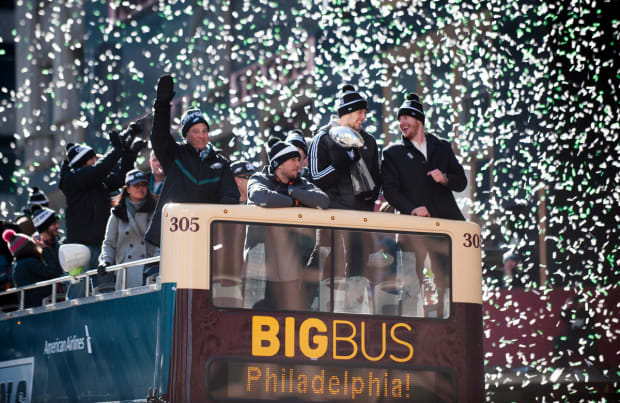
Confetti falls as (from right) QB Carson Wentz, backup QB Nate Sudfeld, Super Bowl MVP Nick Foles and owner Jeffrey Lurie ride a float during the Eagles Super Bowl LII victory parade, Feb. 8, 2018.
Greatest Eagles Quarterbacks of All Time
Some teams have had an embarrassment of riches at the most important position in the game: quarterback. The Packers basically went from Bart Starr to Brett Favre to Aaron Rodgers. The 49ers went from Joe Montana to Steve Young. The Patriots had Tom Brady—who is better all by himself than all the quarterbacks that some teams have had in their entire history combined. Super Bowl wins and enshrinement in the Hall of Fame are normal for some franchise's quarterbacks.
Not so much for the Eagles. If you look at the Hall of Fame, the Eagles don't have a single quarterback who spent the majority of his career playing for the franchise.
Selection Criteria
I was born in 1968, so while I have seen some great Eagles quarterbacks in my day, I spent far too many seasons watching the likes of Bubby Brister, Jeff Kemp, Rodney Peete, A.J. Feeley, Bobby Hoying, Sam Bradford, Mark Sanchez, Kevin Kolb and the Detmer brothers, Ty and Koy, lead the Eagles absolutely nowhere. Oh, the humanity!
Despite this history, there actually have been a few truly great quarterbacks who have led the Eagles—and we will count down the top five here.
For the purpose of this list, I considered only the statistics and accomplishments accumulated while playing for the Eagles. This caveat may upset some fans, but it's the only way to do a list like this.
5. Ron Jaworski
Eagles QB: 1977–86
Drafted: Second-round pick by the Rams in the 1973 NFL Draft out of Youngstown State
Acquired: Via trade with the Rams in 1977
Eagles Hall of Fame Inductee: 1992
Selected in the second round of the 1973 NFL Draft by the Rams, Ron Jaworski was traded to the Eagles in 1977. Known affectionately as "Jaws," he teamed with new coach Dick Vermeil to slowly build the Eagles into a winner. Jaworski led Philadelphia to the playoffs in the 1978 and '79 seasons, but the team had early playoff exits both years. Then came the magical season of 1980.
Jaworski and the Eagles started out the 1980 season 11–1, en route to winning the NFC East with a 12–4 record. The Eagles beat the Vikings in the divisional round of the playoffs before heading to one of the biggest games in the franchise's history.
The Eagles had lost 19 of the previous 23 games they had played against their biggest rival, the Cowboys. Now, Jaworski was leading them into the NFC championship game against that rival. The Eagles reversed their fortunes and beat the Cowboys 20–7 to reach their first Super Bowl in franchise history. The Super Bowl against the Raiders was not Jaworski's or the Eagles' finest hour as they lost 27–10, but it was still an amazing season.
Jaworski completed 57% of his passes for 3,529 yards, 27 touchdowns and 12 interceptions for a 91.0 passer rating during that 1980 season. That earned him first-team All-Pro honors along with several other awards. He still has the record for the second-most yards (26,963) and second-most touchdowns (175) in franchise history.
He finished his Eagles career with a record of 69-67-1, and he started all 16 games during five different seasons. He remains an icon in the city of Philadelphia to this day, and he fits nicely at No. 5 on the all-time list of the greatest Eagles quarterbacks.
4. Tommy Thompson
Eagles QB: 1941–50
Signed: Undrafted free agent signed by the Steelers out of Tulsa
Signed With the Eagles: 1941
Anyone who isn't currently getting a senior citizen discount never got a chance to see Tommy Thompson play quarterback for the Eagles. As old as I am, I can honestly say that I included him on this list strictly on his accomplishments. I say accomplishments, because his statistics weren't exactly great.
While he was technically on the Eagles for 10 years, he actually played only eight seasons. He missed the 1943 and '44 seasons because he was serving in the Army during World War II. During the eight seasons he played, he was a part-time starter who threw for only 10,240 yards with 90 touchdowns and 100 interceptions. These numbers may not sound very impressive, but here's why I believe Thompson deserves to be on this list.
He led the Eagles to three straight NFL championship games in 1947, '48 and '49. The Eagles won the title in 1948 and '49 in bad weather conditions, so Thompson didn't have great stats. But anybody who watched the Eagles lose two Super Bowls due to subpar quarterback play can appreciate a guy who managed to win it all, even as a game manager.
That doesn't mean Thompson was never great. He led the NFL with 25 touchdown passes in 1948. His statistics for the 1949 season were downright dominant for the time. He led the NFL in passer rating (84.4) and touchdown percentage (7.5); it was the third straight season he led the NFL in that category. He completed 54.2% of his passes for 1,727 yards, 16 touchdowns and 11 interceptions. It's also important to remember that the NFL was a very different game in the 1940s. Those stats were enough to earn Thompson an All-Pro nod—and the No. 4 spot on this list.
3. Randall Cunningham
Eagles QB: 1985–95
Drafted: Second-round pick by the Eagles in the 1985 NFL Draft out of UNLV
Eagles Hall of Fame Inductee: 2009
Once dubbed "The Ultimate Weapon" by Sports Illustrated, Randall Cunningham redefined the quarterback position in the NFL. Quarterbacks were traditionally pocket passers before Cunningham burst onto the scene. His ability to throw the ball nearly the length of the field and scramble like a running back was just the beginning of the NFL's evolution at the quarterback position.
Cunningham played sparingly during his first two seasons while backing up Ron Jaworski, but he took over as the starter in Week 11 of the 1986 season. By the 1988 season, Cunningham was leading the Eagles to the NFC East division title and the playoffs. Unfortunately, the Eagles lost "The Fog Bowl" to the Bears, 20–12, but Cunningham threw for 407 yards. That was only the beginning of big things for the Eagles quarterback.
The 1990 season saw Cunningham win the NFL MVP Award by completing 58.3% of his passes for 3,466 yards, 30 touchdowns and 13 interceptions for a 91.6 passer rating. He also had 118 carries for an additional 942 yards and five touchdowns. He led the team to a 10–6 record and another playoff berth.
Unfortunately, Cunningham's 1991 season ended in Week 1 when Green Bay's Bryce Paup sacked him and tore his ACL. The following season, Cunningham returned and won the NFL Comeback Player of the Year Award. He threw for 2,775 yards, 19 touchdowns and 11 interceptions for a 87.3 passer rating. He added another 549 yards rushing and five touchdowns. He capped the 1992 season by leading the Eagles to their first playoff win in 12 years. But it was obvious that the knee injury had robbed Cunningham of some of his mobility.
The following seasons were marred by injuries, and a switch to the West Coast offense led to Rodney Peete taking over as quarterback. Cunningham soured on the game at that point and retired from football after the 1995 season. He came out of retirement with the Vikings, but that's a story for another article.
Cunningham compiled a 63-43-1 record with the Eagles, but his playoff record was only 1–4. He is still third in passing yards (22,877) and sixth in rushing yards (4,482) in franchise history. His 4,928 rushing yards are still the third-most in NFL history by a quarterback.
Cunningham's Eagles career didn't fully deliver on the promise of his unparalleled talents, and it ended on a sour note, but it was still plenty good enough to be considered No. 3 in franchise history.
2. Nick Foles
Eagles QB: 2012–14 and 2017–18
Drafted: Third-round pick by the Eagles in the 2012 NFL Draft out of Arizona
Some may argue that No. 2 is too high a ranking for Nick Foles, but it's hard to argue with the numbers. Not to mention the fact that he is the only quarterback in Eagles history to ever win a Super Bowl.
The Eagles selected Foles in the third round of the 2012 NFL Draft, but he didn't get into a game until Week 10 of that season when Michael Vick got hurt. Foles made his first NFL start the next week, marking the beginning of this unlikely legend. Even though he went 1–6 in 2012, he became the first rookie in NFL history to throw for 240 yards per game while completing 60% of his passes. Breaking records would soon become his norm.
Foles lost a training camp battle to Vick in 2013, but Vick eventually got hurt in Week 5. Foles started Weeks 6 and 7, but the genius that was Chip Kelly decided to start Vick again in Week 8. Vick promptly got hurt again, and it was back to Foles for good. That's when one of the greatest seasons an NFL quarterback has ever had really took off.
Foles decided that he needed another NFL record to break. In Week 9, he tied an NFL record with seven touchdown passes against the Raiders.
For the season, he went 82 in his 10 starts and led the Eagles to a surprising NFC East division title. He lost his first playoff start that year, but he left the field with a lead late in the fourth quarter—only to have his special teams give up a long return before the defense allowed a game-winning field goal to the Saints. As impressive as that was, his stats were even better. He completed 64% of his passes for 2,891 yards, 27 touchdowns and only two interceptions, and he had a league-leading 119.2 passer rating during that 2013 season.
The next season wasn't kind to Foles. He had pedestrian stats before his season was ended early in Week 9 by a broken collarbone. Chip Kelly proved once again that he was in over his head when he traded Foles to the Rams for Sam Bradford. Foles played for the Rams in 2015 and then the Chiefs in '16. He then re-signed with the Eagles in 2017 to back up Carson Wentz.
Every Eagles fan knows what happened next. Wentz got hurt in Week 14, and Foles led the Eagles to the first Super Bowl championship in franchise history.
Foles completed 28 of 43 passes for 373 yards, three touchdowns and one interception in the Super Bowl. He also became the first player in NFL history to both throw and catch a touchdown pass in the Super Bowl. His famous play call (Philly Philly) is still immortalized with a statue outside of Lincoln Financial Field today. I walk by it every home game on my way to my seats.
Nick Foles Stats (in only 32 starts)
Highest career passer rating in team history (93.2)
Highest single-season passer rating in team history (119.2 in 2013)
9th in franchise passing yards (8,703)
8th in franchise touchdown passes (58)
Lowest interception percentage in a season in team history (0.63 in 2013)
Most yards passing in a game in team history (471 on Dec. 23, 2018, vs. the Texans)
Most touchdown passes in a game (7 on Nov. 3, 2013, at Raiders), which tied a franchise and NFL record
His 27 touchdowns and only 2 interceptions in 2013 was the best TD-INT ratio in NFL history at the time
His 119.2 passer rating in 2013 is 3rd all-time, trailing only Aaron Rodgers' 122.5 rating in '11 and Peyton Manning's 121.4 rating in '04
Foles may have been an Eagle for only five seasons, but they were five mostly magical seasons that included the franchise's only Lombardi Trophy.
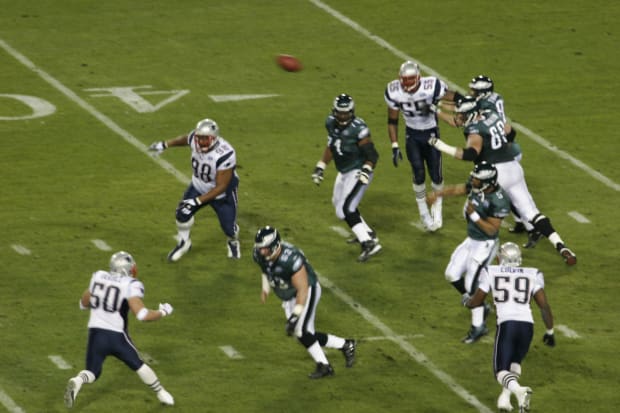
Former Eagles quarterback Donovan McNabb throws a pass during Super Bowl XXXIX.
1. Donovan McNabb
Eagles QB: 1999–2009
Drafted: No. 2 overall pick by the Eagles in the 1999 NFL Draft out of Syracuse
Donovan McNabb didn't have the normal career of a top franchise quarterback, but that doesn't mean that he didn't put up the numbers and wins to earn this spot at the top of this ranking.
The Eagles took McNabb with the second overall pick of the 1999 NFL Draft. The franchise quarterback didn't receive the warmest of welcomes, however, as a busload of knuckleheads went to the draft to boo his selection. Unfortunately, McNabb never forgave Eagles fans, as a whole, for the misdeeds of a handful of fans. This thin-skinned reaction would become the norm for McNabb, and it kept him from becoming the beloved icon a franchise quarterback in Philadelphia should be.
McNabb's rookie year was uneventful as he only started six games. The starter in those other games during the 1999 season? None other than the current Eagles head coach and Super Bowl champion, Doug Pederson. By the next season, McNabb was entrenched as the starter and would remain there for a decade.
McNabb led the Eagles to the playoffs in his first season as the starter in 2000 and even won a playoff game. In 2001, he led the team to the playoffs again and they advanced to their first NFC championship game since 1980. Losing to the Rams "Greatest Show on Turf" team was certainly nothing to be ashamed of. Unfortunately, this would be the first of numerous failed attempts in the NFC championship game; McNabb would have a record of 1–4 in that game. Of course, at this point, the fans had no reason to doubt that McNabb was going to lead the team to greatness.
The Eagles won the NFC East four straight years between 2001 and '04 while McNabb was establishing himself as one of the stars of the league. The only problem was that he couldn't get that last win to get his team into the Super Bowl. That all changed in 2004 when head coach Andy Reid finally decided it would be a good idea for a passing offense to have a great wide receiver. The Eagles got Terrell Owens, who teamed with McNabb to lead the team to the promised land.
Unfortunately, McNabb once again couldn't come through in the biggest game of the season as he coughed up the Super Bowl to the Patriots. This was during the heyday of their Spygate days. But that doesn't mean that 2004 wasn't a magical season. In fact, it was the best season of McNabb's career.
In 2004, McNabb became the first quarterback in NFL history to finish the season with over 30 touchdown passes and fewer than 10 interceptions. He completed 64% of his passes for 3,875 yards, 31 touchdowns and 8 interceptions for a 104.7 passer rating. He also added three rushing touchdowns on only 41 carries.
The Super Bowl hangover was real for the Eagles the next season. T.O. wanted a new contract and began feuding with McNabb. The whole circus ended up with Owens doing sit-ups in his driveway while reporters tried to ask him questions about being banished from the team. McNabb ended the season on the Injured Reserve after only nine games.
The 2006 season wasn't much better, as McNabb tore his ACL and only played in 10 games. The Eagles actually finished first in the NFC East in 2006 behind backup quarterback Jeff Garcia, who went 5–1 as a starter and even won a playoff game that season.
McNabb returned for the 2007 season, but the whole team struggled. Somehow, McNabb and the Eagles had a resurgence in 2008 that ended in yet another loss in the NFC championship game. He even set his career high in passing yards (3,916) that season. His last season in Philadelphia (2009) ended with a playoff loss to the rival Cowboys in the wild-card round of the playoffs. McNabb was traded that offseason.
Donovan McNabb Records:
Winningest quarterback in Eagles history (92 wins)
Most pass attempts in franchise history (4,746)
Most completions in franchise history (2,801)
Most passing yards in franchise history (32,873)
Most touchdown passes in franchise history (216)
Led NFL in quarterback wins between 2000 and '04
McNabb finished his Eagles career with a 92-49-1 record (he famously didn't know NFL games could end in a tie). His playoff record was 9–7; he threw for 3,752 yards, 24 touchdowns and 17 interceptions for an 80.0 passer rating in those 16 games. He also ran for 422 yards and four more touchdowns in the playoffs.
McNabb may have had his issues in NFC championship games and lost his only Super Bowl, but he was only the second quarterback to even lead the Eagles franchise to a Super Bowl. That, and all of the team records that he still owns, make him the choice for the top quarterback in Eagles history.
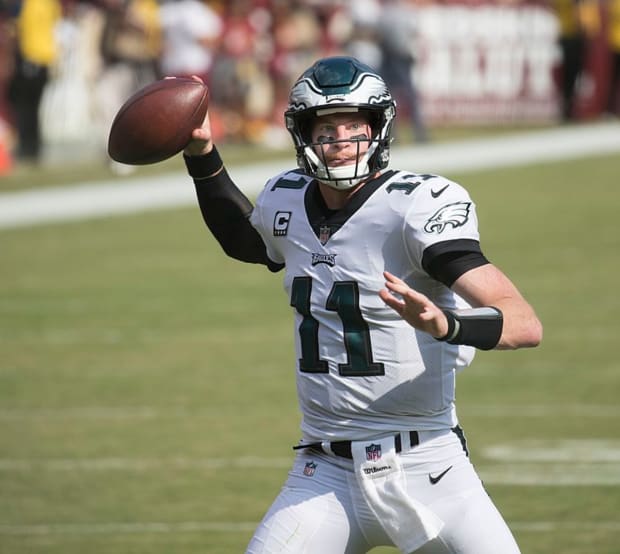
Eagles quarterback Carson Wentz
Honorable Mentions
The following three players didn't quite make the cut for the greatest Eagles quarterbacks of all time, but they still made important contributions to the franchise. They are listed here in order of their importance.
Carson Wentz
Eagles QB: 2016–Present
Drafted: No. 2 overall pick by the Eagles in the 2016 NFL Draft out of North Dakota State
There may be plenty of Eagles fans who will be upset that Carson Wentz didn't make the list of the top five quarterbacks, but the truth is that he just hasn't played enough games yet to beat out any of the guys on the list. That being said, he has already amassed some amazing stats during his career.
Eagles records Wentz already holds (as of the 2019 season):
Fifth most pass attempts in franchise history (2,055)
Fourth most completions in franchise history (1,311)
Fifth most touchdown passes in franchise history (97)
Second best career quarterback rating in franchise history (92.7)
Second best career completion percentage in franchise history (63.8)
Fifth most passing yards in franchise history (14,191)
Most touchdown passes in a season in franchise history (33 in 2017)
Most passing yards in a season in franchise history (4,039 in 2019)
What's really holding Wentz back is that he wasn't able to finish two of his four seasons due to injury. In addition, he has only played in one playoff game—and he only threw four passes in that one because he got hurt.
Of course, Wentz had one of the best seasons of any Eagles quarterback. Sure, his 2017 ended in Week 14, and Nick Foles led the team to victory in the Super Bowl, but Wentz had the team at 11–2 when he got hurt. He completed 60.2% of his passes in 2017 for 3,296 yards, 33 touchdowns and 7 interceptions for a 101.9 passer rating in only 13 games. Those 33 touchdown passes broke a 56-year-old record, previously held by Sonny Jurgensen, and were still the second-most in the NFL that season. He was running away with the MVP award before he blew out his ACL on a touchdown run against the Rams.
I'm sure Wentz will be on any list of the greatest Eagles quarterbacks starting next season, and he might just challenge McNabb for the top spot one day. But for now, he just needs more time and good health to build his stats and his resume.
Norm Van Brocklin
Eagles QB: 1958–60
Drafted: Fourth-round pick by the Rams in the 1949 NFL Draft out of Oregon
Acquired: By the Eagles in a 1958 trade with the Rams
Eagles Hall of Fame Inductee: 1987
Pro Football Hall of Fame Inductee: 1971
Old-school fans may believe that Norm Van Brocklin rightfully belongs among the top five on this list. However, like Wentz, Van Brocklin simply didn't play enough games for the Eagles to be ranked among the best.
The Eagles acquired Van Brocklin in a 1958 trade with the Rams, and he went on to be the starting quarterback for three seasons. He had already established himself as one of the best quarterbacks of his era with the Rams, but for the purposes of this list we are only considering his Eagles career. Of course, the highlight of his time with Philadelphia was the 1960 season.
In that season, his final one in the NFL, Van Brocklin led the Eagles to the NFL championship over the Vince Lombardi–led Packers. Amazingly, Van Brocklin was the only quarterback to ever beat the Lombardi Packers in the playoffs. It was also his best year as an Eagle statistically, with 2,471 yards passing, 24 touchdowns and 17 interceptions for an 86.5 passer rating. By today's standards these numbers may not seem impressive, but in those days defenses could actually hit offensive players and teams weren't throwing the ball on over 60% of their plays.
For his Eagles career, Van Brocklin threw for 7,497 yards, 55 touchdowns and 51 interceptions. He was a Pro Bowler in all three of his seasons in Philadelphia and was elected to the Pro Football Hall of Fame in 1971.
Sonny Jergensen
Eagles QB: 1957–63
Drafted: Fourth-round pick by the Eagles in the 1957 NFL Draft out of Duke
Eagles Hall of Fame Inductee: 1983
Pro Football Hall of Fame Inductee: 1987
Much like the other honorable mentions on this list, Sonny Jergensen didn't play for the Eagles long enough to make the top five. Sure, Jergensen was elected to the Pro Football Hall of Fame in 1983, but a lot of that had to do with his 10 years with Washington. The Eagles traded him for Norm Snead after an injury-plagued 1963 season.
Jergensen was the backup to Van Brocklin for four years, and he didn't get a chance to start until 1961. He made up for lost time by leading the NFL in passing yards in back-to-back seasons in 1961 and '62. His 1961 season was especially great as he led the NFL with 235 completions for 3,723 yards and 32 touchdowns. Those 32 touchdown passes were a franchise record for 56 years, until Carson Wentz broke that record with 33 touchdown passes in 2017.
Jergensen finished his Eagles career with 9,639 passing yards, 76 touchdowns and 73 interceptions.
The who's who of Sydney at Dior's Couture Cruise 2019 Collection launch; and Hollywood icon Jamie Lee Curtis fronts the Halloween premiere. By Amy Croffey - amy.croffey@fairfaxmedia.com.au.
from Sydney Morning Herald - Latest News Read More
Decades after its glory days, Tupperware is suddenly an 'it brand' again. This time around it's not social gatherings, but social distancing fuelling its sales.
from Sydney Morning Herald - Business https://ift.tt/2JcOx0h Read More
The winner of the race for the White House will have millions of Americans struggling to get back to work because of a health crisis not seen in more than 100 years.
from Sydney Morning Herald - Business https://ift.tt/3oBY9SI Read More
Garry Hounsell, the embattled chairman of department store Myer, has stepped down after losing the support of the retailer's two largest shareholders ahead of its annual general meeting.
from Sydney Morning Herald - Business https://ift.tt/3oyLCzf Read More
The Cardinals have had plenty of explosive offensive players in its 100-year history, and this article will count down the franchise's 10 best wide receivers of all time.
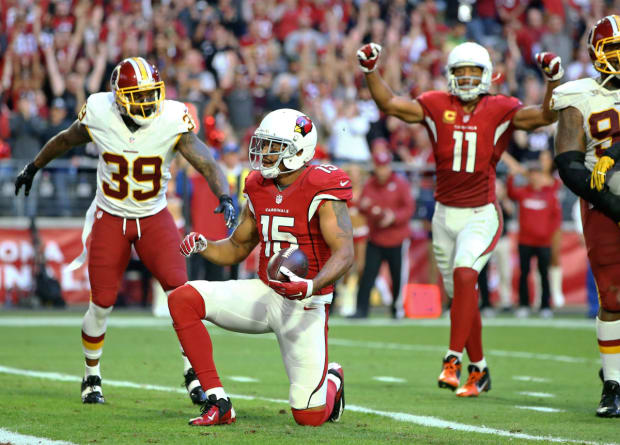
Arizona receivers Michael Floyd (15) and Larry Fitzgerald (11) celebrate after Floyd scored against Washington in 2016. Both are among the 13 players in Cardinals history to catch more than 1,000 receiving yards in a season.
The Top 10 Cardinals Wide Receivers of All Time
When it comes to wide receivers, the Cardinals know how to pick them. The team has had at least one bona fide receiver in its lineup for almost every season since the 1960s, and it has watched one of its players rack up at least 900 receiving yards in a season 52 times. Thirteen players have taken that a step further by gaining 1,000 yards in a season. With that history, several players are in the mix when considering the best wide receivers in franchise history.
Wide receiver legends have come in a steady stream for the Cardinals. The 1970s were a little sparse in terms of production, but several memorable receivers still took the field, and the '80s brought about the greatest receiver the franchise had seen. Then, starting in the late 1990s, the position solidified, and more legends were born. Multiple Arizona receivers have caught more than 1,000 yards in the same season five times since 1997—including three players who achieved the feat during the 2008 season. Since that year, which saw Arizona's offense propel the team to Super Bowl XLIII, production from the position had stayed strong, and the future remains bright.
Selection Criteria
Legacy Honors (Hall of Fame, Ring of Honor, retired number, etc.)
Single-Season Honors (MVP, All-Pro, Pro Bowl, etc.)
Longevity (years with the Cardinals, percentage of career with the Cardinals, etc.)
Only games played with the Cardinals are factored into this list, so while Gary Clark would be a great player to include on a list about Washington, his two seasons of strong production with the Cardinals won't place him in the top 10 here. Additionally, only wide receivers are included, so neither great tight end Jackie Smith nor pass-catching fullback Larry Centers will be listed here.
Following this list are a handful of honorable mentions as well as statistics from every 1,000-yard receiving season in team history.
10. David Boston
Years With the Cardinals: 1999–2002
Pro Bowl: 2001
All-Pro: 2001
David Boston was a brash rookie out of Ohio State who was in and out of the starting lineup during the 1999 season. But once he focused more on football instead of showboating, he became a superstar for the Cardinals. Boston was the No. 8 pick in the 1999 NFL Draft and had the expected growing pains of a rookie. Every now and again, however, he showed flashes of brilliance that justified his draft position.
In his fifth game of his rookie season, Boston caught eight passes for 101 yards and his first career touchdown in a win over the Giants. He doubled his career reception total and nearly tripled his career yardage total with that effort, but he wouldn't cross the 100-yard threshold again the rest of the season. After being moved into a feature role his sophomore season, he caught a pair of touchdowns in the season opener, then added a 184-yard performance later in the season. He was targeted at least six times in all but two games, setting up the stage for a breakout season in 2001.
While racking up nine games with more than 100 receiving yards, Boston was a one-man offensive show in Arizona, and he used 58 yards in the last game of the season to become the franchise's new all-time leader for single-season receiving yardage. That record of 1,598 yards still stands, and his breakout was attributed to improved technique and focus on the game, as well as reshaping his body to build strength without sacrificing speed.
Boston was unable to follow up on his 2001 success, as he suffered a season-ending knee injury in Week 9 in 2002. Due to a DUI arrest and a failed drug test, the Cardinals declined to re-sign him as a free agent in 2003. He bolted to the Chargers for a big contract instead, leaving Arizona with 241 catches for 3,739 yards and 18 touchdowns.
David Boston: Cardinals Stats
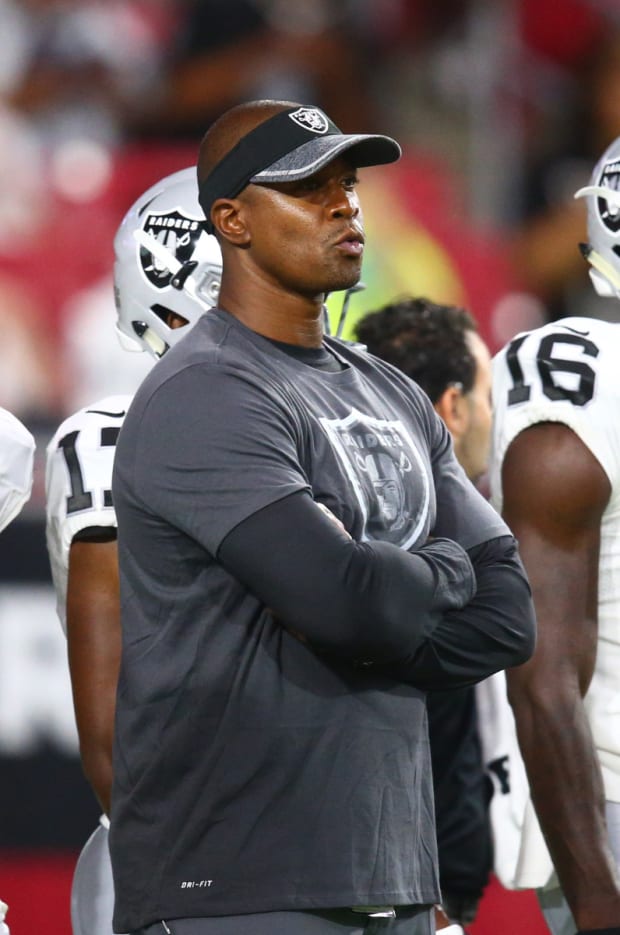
Raiders assistant coach Rob Moore watches his team play against the Cardinals during a 2016 preseason game. Moore is among the most significant receivers in Cardinals history.
9. Rob Moore
Years With the Cardinals: 1995–99
Playoff Appearances: 1998
Pro Bowl: 1997
All-Pro: 1997
The Cardinals put up a small bounty to acquire Rob Moore from the Jets, netting the veteran receiver in exchange for their first-round draft pick and running back Ronald Moore. The franchise rewarded Rob Moore with the richest contract in team history, and he rewarded their confidence with five productive years.
Following the 1994 season, the Cardinals were in desperate need of receivers after parting ways with three of them, and Moore provided both a consistent big-play threat alongside second-round draft pick Frank Sanders. Together, Moore and Sanders provided a steady tandem that helped push the Cardinals into the 1998 playoffs—and between two postseason games, Moore was targeted 26 times and gained 132 yards on 11 receptions.
Altogether, in his five seasons, Moore caught 322 passes for 5,110 yards and 27 touchdowns. That included a monster season in 1997, which saw him lead the league with a then-franchise record 1,584 yards, 176 yards ahead of runner-up Tim Brown. He was just 16 yards shy of becoming the 21st player to average 100 yards per game in a season.
Rob Moore: Cardinals Stats
8. Bobby Joe Conrad
Years With the Cardinals: 1958–68
Pro Bowl: 1964
All-Pro: 1963
Bobby Joe Conrad didn't start his career as a wide receiver, but by the time he was permanently placed at the position in 1962, he was ready to prove that he belonged. Formerly a two-way player at Texas A&M, Conrad was drafted by the Giants as a defensive back in 1958 but was traded to the Cardinals a few months later. There he spent one season on defense, then was used primarily in the rushing attack for the next two years.
The Cardinals moved Conrad to flanker in 1962, and the experience he gained set up his two finest receiving seasons. He never crossed the 1,000-yard threshold, but he was consistently in the box score every game the next two seasons, catching at least two passes in all 28 games. In 1963, he led the league with 73 catches, setting a franchise record that would stand for two decades.
Conrad started every game for the next five seasons, and from 1961 to '68 he caught a pass in 101 straight games. After that streak ended, he played a final season in a reserve role close to his home in Texas with the Cowboys. He ended his career with the Cardinals after catching 418 passes for 5,828 yards and 38 touchdowns.
Bobby Joe Conrad: Cardinals Stats
7. Frank Sanders
Years With the Cardinals: 1995–2002
Playoff Appearances: 1998
Frank Sanders had very little time to adjust to the NFL. As a second-round draft selection of the Cardinals in 1995, Sanders was immediately thrown into a major role as the team rebuilt its receiving corps. He caught at least one pass in the first 15 games of his career, and he showed big-play potential by averaging nearly 17 yards per catch. His best rookie game came in Week 6, when he came away with 108 yards and his only two touchdowns of the season in a loss to the Giants.
Sanders rarely posted gaudy statistical numbers, instead helping spread the field and draw defenders away from superstars like Rob Moore and David Boston. But Sanders always made sure to play his part, too. From 1996 to 2001, he played every game and failed to catch a pass in only three of them. His best individual games both came in losses for Arizona. During Week 12 of 1997, Sanders hauled in nine passes for 188 yards in a 19–10 loss to the Giants; and in Week 11 of 1998, he caught 11 passes for 190 yards in a 35–28 loss to the Cowboys.
Sanders left for the Ravens after the 2002 season. While with the Cardinals, he caught 493 passes for 6,579 yards and 24 touchdowns.
Frank Sanders: Cardinals Stats
6. Pat Tilley
Years With the Cardinals: 1976–86
Pro Bowl: 1980
Pat Tilley was just 5'10" and 178 pounds when he was selected by the Cardinals in the fourth round of the 1976 NFL Draft. A product of Louisiana Tech, he didn't play too often as a receiver in his first two seasons, but then he became a mainstay for the team's offense. He missed just three games from 1978 to '85, and he amassed at least 690 yards each of those seasons except the strike-shortened '82 campaign.
Going into the 1986 season, Tilley was just 15 receptions shy of breaking the franchise record, but he'd play just one game. In the season opener, he snared three passes for 51 yards on a pulled hamstring—but later in the week he was placed on injured reserve due to a severe back injury. He would never return, but he will also never be forgotten by Cardinals fans after catching 468 passes for 7,005 yards and 37 touchdowns.
Pat Tilley: Cardinals Stats
5. Sonny Randle
Years With the Cardinals: 1959–66
Pro Bowl: 1960–62, 1965
All-Pro: 1960
Sonny Randle was one of two rookie receivers tasked with trying to help rebuild the Cardinals' offensive attack in 1959. In spite of his speed, Randle struggled to establish himself in his first season—playing five games and scoring just once. That would all change in his sophomore season, in which he led the league in touchdowns and finished sixth in receptions. In four games that season, including the season opener, he caught three touchdown passes.
Throughout his career, Randle typically started the season strong, catching seven career touchdowns in Week 1. He also grabbed two touchdowns in his first game of the 1961 season, but those came in Week 2. In 1962, Randle had the best individual game of his career, when he hauled in a since-tied franchise record 16 passes in a single game for 256 yards and a touchdown. That helped push him over the 1,000-yard mark for the season, a feat he would repeat in 1963.
During the following season, Randle was on pace for more than 1,000 yards again, but he suffered an injury midseason. He left the Cardinals after the 1966 season with a career total 328 receptions for 5,438 yards and 60 touchdowns. He held the franchise record for career receiving touchdowns until 1989 and still holds the single-season record.
Sonny Randle: Cardinals Stats
4. Anquan Boldin
Years With the Cardinals: 2003–09
Playoff Appearances: 2008–09
Pro Bowl: 2003, '06, '08
Major Awards: Offensive Rookie of the Year (2003)
Anquan Boldin had one of the best-ever starts to an NFL career after being taken as a second-round draft pick in 2003. He had 217 receiving yards in his first game, and he had an additional four more games of at least 100 yards on his way to winning the Offensive Rookie of the Year award. Boldin was honored after the season a second time when he was the only rookie selected to the Pro Bowl. Two years later, he averaged more than 100 yards per game, despite missing two games with an injury.
As a part of a prolific offense that featured quarterback Kurt Warner and fellow receiver Larry Fitzgerald, Boldin continued to produce numbers that have him in contention for election into the Hall of Fame when he becomes eligible in 2022. Along the way, he became the fastest player to reach 200, 300, 400 and 500 career receptions. His efforts helped the Cardinals appear in Super Bowl XLIII, and he caught a 71-yard touchdown during the 2008 postseason.
In Boldin's time with the Cardinals, he caught 586 passes for 7,520 yards and 44 touchdowns. He maintains league records with 217 yards in his first game and 101 receptions in his first season. Going into 2020, he held team records with his 100.1 yards per game average from 2005, as well as his 6.2 receptions per game from his seven years with the team.
Anquan Boldin: Cardinals Stats
3. Mel Gray
Years With the Cardinals: 1971–82
Playoff Appearances: 1974–75
Pro Bowl: 1974–77
All-Pro: 1975
Mel Gray was a two-sport standout at Missouri, and he stayed near school when the Cardinals selected him in the sixth round of the 1971 NFL Draft. The speed that made him a track star proved to be an asset for the Cardinals, and they used him to lengthen the field throughout his 12-year career. In all but three of his seasons, he caught a pass of at least 69 yards and went for an 80-yard touchdown three times. Twenty of his 46 career touchdown passes were for at least 50 yards, and nine of his first 10 scores went for at least 40 yards.
Gray never caught 1,000 yards in a season, but his consistent big-play ability and sure hands made him a reliable asset for the franchise. His 18.9 yards per reception are the most among Cardinals players with at least 150 catches, and his four fumbles are the fewest in team history among receivers to play 100 or more games.
In his final season, Gray was on pace to break the NFL record for consecutive games with a reception, but he had to settle for a streak of 121 such games, with just four catches in five games in his final season. During his long Cardinals career, Gray was on the receiving end of 351 passes for 6,644 yards.
Mel Gray: Cardinals Stats
2. Roy Green
Years With the Cardinals: 1979–90
Pro Bowl: 1983–84
All-Pro: 1983–84
Legacy Honors: Cardinals Ring of Honor
Roy "Jet Stream" Green didn't come into the NFL in 1979 with high expectations as a fourth-round pick out of Henderson State in Arkansas. He didn't come with expectations to be a wide receiver, either. It wasn't until his third season in the league that he made the part-time switch after coaches observed him playing catch in practice. The year was 1981 and the Cardinals needed receivers—so they turned to Green, who was one of their defensive backs and a kick returner.
Green accepted the challenge, and he became one of the league's best. He averaged 21.5 yards per catch that season—including a 60-yard scamper on his first reception of the season. In his second game as a receiver, he caught a touchdown and intercepted a pass on defense, becoming the first player to do so since 1966.
During the following season, Green became a full-time receiver, and he had 170 yards in one game of the strike-shortened 1982 season. With a full slate of games in 1983, Green eclipsed the 1,000-yard mark for the first time while leading the league with 14 touchdowns—four of which came in a win over Seattle. His final tally of 1,227 yards set a new single-season franchise record.
His 1984 campaign was even better. He smashed his newly minted record with a league-best 1,555 receiving yards on the strength of five games, where he finished with 160 yards or more. Included was a three-game stretch that saw him make 20 catches for 518 yards, as well as a blistering finale of eight catches, for a career-high 196 yards. Injuries would slow him the next several seasons, however, and while he would lead the team in receiving yardage one more time (with 1,097 in 1988), he only gained 100-plus yards in a game nine times between 1985 and '90.
The Cardinals looked to make their roster younger for the 1991 season, and they traded Green to the Browns. Green left the Cardinals holding franchise records for receptions (522), receiving yards (8,496) and touchdowns (66), and he was memorialized in the franchise's Ring of Honor in 2016.
Roy Green: Cardinals Stats
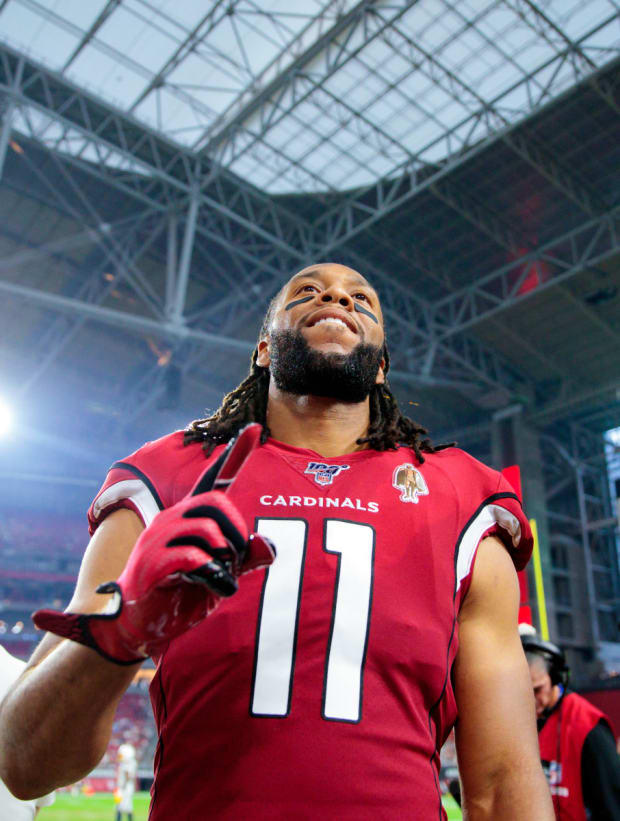
Larry Fitzgerald is the best wide receiver in Cardinals history. Still active, he already owns the majority of the franchise's receiving records.
1. Larry Fitzgerald
Years With the Cardinals: 2004–present
Playoff Appearances: 2008–09, 2014–15
Pro Bowl: 2005, 2007–13, 2015–17
All-Pro: 2008
Major Awards: Pro Bowl MVP, 2008
Legacy Honors: NFL 100 All-Time Team
There is no argument that the greatest wide receiver in Cardinals history is Larry Fitzgerald. A model of consistency throughout his entire career, Fitzgerald has been the face of the Cardinals since 2004, missing just six games in that span. With nearly double the yardage and touchdowns of any other player in franchise history, he has established himself as a legend and holds most every receiving mark in the Cardinals' record book. He will undoubtedly become the first receiver in team history to be a first-ballot electee to the Hall of Fame (assuming Anquan Boldin doesn't beat him to it).
Fitzgerald was a first-round draft selection out of the University of Pittsburgh and was picked up by Arizona to carry on the tradition of standout receivers. The Cardinals couldn't have known at the time that they had selected the player who would become one of the greatest wide receivers in NFL history. He's twice led the league in receptions (2005 and '16) and touchdown catches (2008–09). From the middle of 2004 through the '19 season, he caught a pass in 243 straight games in which he played.
In both the 2005 and '08 seasons, he had seven games with more than 100 receiving yards. Sandwiched between those years were two of his best individual games—an 11-catch, 172-yard effort in 2006, and an 11-catch, 171-yard effort in '07. He set a career high with three touchdowns in a 2015 matchup against the Bears. All told, he has 49 games with at least 100 receiving yards, and he has scored at least twice in a game 19 times.
Among Fitzgerald's franchise records are 1,378 catches for 17,083 yards and 120 touchdowns (current through the 2019 season). He also has 10 postseason touchdown catches and appeared in Super Bowl XLIII, a game in which he caught a pair of touchdowns. All-time among NFL receivers, Fitzgerald is second in career receptions and receiving yardage, and he is sixth in career receiving touchdowns. He was the youngest player to reach 700, 800, 900 and 1,000 receptions for his career. He has also been active off the field, donating time and money to numerous causes over the course of his career.
Larry Fitzgerald: Cardinals Stats
Honorable Mentions
With so many standout wide receivers in Cardinals history, listed below are several players who also left an indelible mark on team history but didn't quite make the top 10.
J.T. Smith
J.T. Smith had two 1,000-yard receiving seasons for the Cardinals, and he nearly had a third. He led the league with 91 catches for 1,117 yards in 1987. That season was a solid follow-up to his 1986 campaign, which saw him snare 80 passes for 1,014 yards. He finished with 986 yards in 1988. From 1985 to '90, he caught 377 passes for the team, racking up 4,701 yards and 27 touchdowns.
Ricky Proehl
Ricky Proehl made his mark right away after getting selected by the Cardinals in the third round of the 1990 NFL Draft. He set the team's rookie record with 56 catches (since beaten by Anquan Boldin) for 802 yards. Prohel was very consistent, closing each of his four seasons with the Cardinals between 651 and 877 receiving yards. His career totals with the team were 287 receptions for 3,840 yards and 21 touchdowns.
Michael Floyd
Michael Floyd was a first-round draft pick of the Cardinals in 2012, and he went to work right away, catching his first career pass for a touchdown. He would gain 1,041 yards his sophomore season, including 193 yards in a game against Jacksonville. Floyd followed this with back-to-back seasons where he finished over 800 yards. He was released during the 2016 season after a DUI arrest. During his time with the Cardinals, he caught 242 passes for 3,739 yards and 23 touchdowns.
John Gilliam
John Gilliam only played three seasons with the Cardinals, but he made those years count. In 1969, he caught 52 passes for 997 yards and nine touchdowns; in 1970, he hauled in 45 passes for 952 yards and five touchdowns; and in 1971, he pulled down 42 passes for 837 yards and three touchdowns. He averaged 20 yards per reception during his tenure.
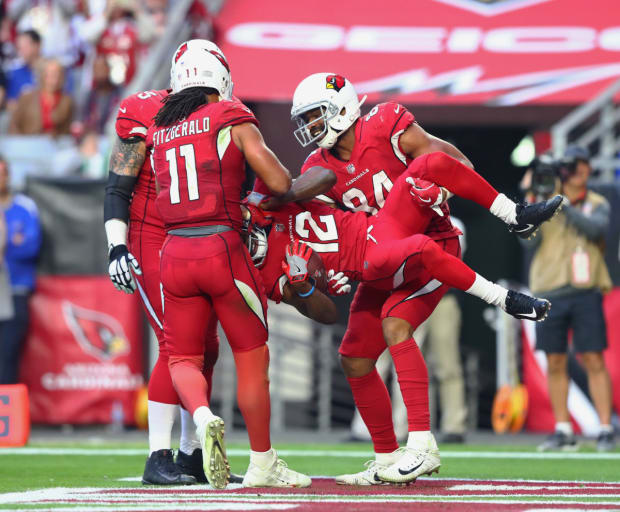
Cardinals wide receiver John Brown (12) is lifted by tight end Jermaine Gresham (84) as he celebrates a third-quarter touchdown with Larry Fitzgerald (11) against the Giants.
Cardinals Wide Receiver History
The following is a look at the franchise receiving records and individual statistics for every 1,000-yard receiving season in the history of the Cardinals, from their beginnings in Chicago through their move to St. Louis and finally to the present day in Arizona.
Cardinals Receiving Records
Below are prominent records among wide receivers that are contained in the Cardinals franchise record book.
Career Yards: 17,083, Larry Fitzgerald (2004–present)
The Crossover staff debates if a late December start date is too soon.
As we inch toward the end of the year, the start of the next NBA season is still up in the air. A fair amount of star players are pushing the league to start the 2020-21 season on Jan. 18, according to Yahoo Sports' Chris Haynes. Meanwhile, the NBA league office reportedly told the Board of Governors that Dec. 22 is the targeted start date for the 2020-21 season, according to The Athletic's Shams Charania. The Crossover staff debates if a late December start date is too soon.
Michael Rosenberg
Since 2020 is such a backward year, I guess it's fitting that I will answer this one backwards: Figure out when you want the Finals, and go from there.
The recent bubble Finals showed us that the crowded fall sports calendar is not the right time for the NBA Finals—true hoop heads and fans of the teams involved will watch, but casual fans have a lot of options. June is not just the traditional spot for the NBA Finals, it is probably the best time.
Moving to August sounds good in theory because it's a dead spot on the calendar, but the problem is that it's not really a dead spot. Football is already dominating the sports news cycle, and while I have no earthly idea why anybody would watch an NFL preseason game instead of an NBA Finals game, the fact is some people will. July could work, but more people go on vacation then and it's harder to get their attention. So I would start with a June Finals and work backward.
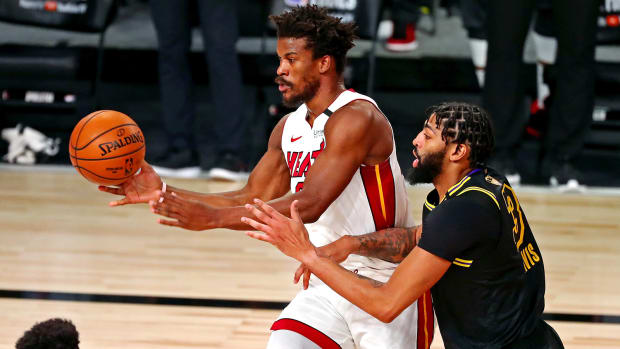
The top priority for the NBA should be having a legitimate, safe season, which means a) long enough to be a real season but b) safe for everybody involved, which means strict COVID-19 protocols and enough time off for the players between seasons. A Christmas Day start would be challenging for the Lakers and Heat, who stopped playing in mid-October. But it would work for everybody else, and the Lakers and Heat, remember, had no games from mid-March to July. So I'd start in late December.
Jeremy Woo
If Dec. 22 is really the best way to maximize the financial health of the league, then I don’t think it’s a major issue. I don’t know when fans can come back, and otherwise I don’t really see the point in waiting.
Ensuring the Finals take place in June and the league calendar can move closer to normal is a significant payoff. Also, selfishly, I love international basketball and want the Olympics to be relevant.
The Lakers and Heat might appreciate some added time off, but I’m sure the majority of teams are itching to get back to normal. The major downside is a compressed offseason that’s going to make the draft, free agency and training camp into a serious crunch for teams. But unless waiting until January is totally necessary, starting ASAP makes enough sense.
Mark Bechtel
My initial reaction was to start on Feb. 1, which is the first day of Black History Month. It would certainly be a nice symbolic gesture, but, alas, that’s the Monday of Super Bowl week, which means that the first games would be overshadowed by columns about the wacky questions asked at Media Day or whatever they’re calling it now.
That brings us back to Christmas, which just seems too early. So why not do this? Start the season on Martin Luther King Jr. Day. But plant a flag on Christmas Day. There are plenty of players who haven’t been on the court since March, and many more who left the playoffs early and will have had adequate rest. Invent some sort of made-for-TV bonanza, kind of like All-Star Weekend all mashed into one day. (Tape it if you don’t want to do it on Christmas Day.) Go nuts. Have a HORSE contest. Have Dr. J play Larry Bird in one-on-one. Stage the ultimate three-on-three tourney. Will it cannibalize All-Star Weekend? No, because they should cancel it in 2021 in the interest of getting the season done as early as possible.
Melissa Rohlin
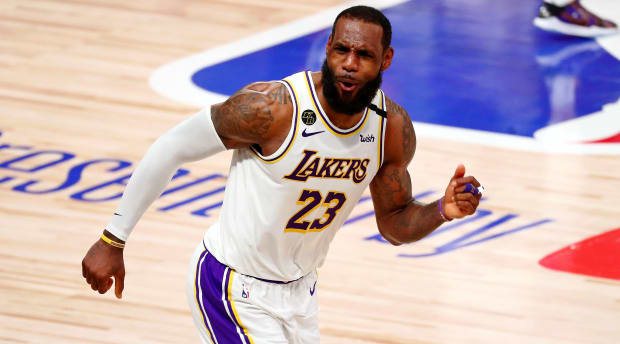
Definitely not any time in December. LeBron James just saw his children a few weeks ago after being apart from them for over 100 days. You think he's going to be anxious to begin traveling anytime soon? The face of the league will surely not be on board with that.
The late-December start date is just insane. Sure, players had a four-month hiatus—but it wasn't a real mental or physical break. They were constantly preparing to return. That's psychologically taxing. They need a real break.
From the league's perspective, a quick return makes sense. They want to make up for lost revenue. But I can't imagine that players will be okay with playing so soon after a season that lasted nearly 12 months. The players need a break. Not to mention the reporters ...
Michael Shapiro
A Dec. 22 start to the 2020–21 season certainly feels rushed, even when considering the havoc COVID-19 wreaked on the NBA calendar. But it's sensible for the league to get started as soon as possible. Shifting the season permanently to a December start feels untenable, and there is ground to cover in order to get the league calendar back on track. The Finals in June and free agency in July is still the best route for the NBA.
Perhaps the first week of January or Martin Luther King Day could make sense for the start of 2020–21. But waiting until fans arrive isn't the best path, nor is a lengthy offseason. Pushing the season opener close to the start of 2021 makes the most sense.
Ben Pickman
For the best interest of the players and the on-floor product, the NBA shouldn’t start until Martin Luther King Jr. Day, at the earliest.
The Lakers’ championship is just over two weeks old and a possible mid-December start date feels like it would unfairly penalize the league’s most recent Finals participants. Having the draft, start of free agency and beginning of training camp all occur within a two-week span feels like an entirely too short period for all the possible player movement, especially when you consider the uptick in COVID-19 cases around the country will bring in questions about whether players could move to new cities safely.
While the start date of the league is certainly important, a bigger question also might be when the league hopes to end the season. The Tokyo Olympics loom large in the league’s 2020–21 season schedule, and fans can only hope the league balances international considerations with its own domestic interests. Of course, it should be no surprise that owners are looking to start the season as soon as they reasonably can. But the most altruistic choice is to push the start of next season back to mid-to-late January at the earliest.
Elizabeth Swinton
Starting the 2020–21 season by Christmas Day seems to be the NBA's most attractive option, but is it reasonable?
Without a bubble, any plan the NBA makes for the regular season will likely need to account for game postponements—such as what the NFL has dealt with amid positive COVID-19 cases. Starting the season in December would allow the league to budget room for rescheduled matchups while continuing to limit back-to-backs.
The longer the season’s start is delayed, the more the league will be restricted in inching toward normalcy and holding a full season and playoffs. Load management may be prevalent, but a December start would likely give the NBA the best chance at navigating a season outside a bubble where conditions cannot be fully controlled.
Robin Lundberg
I like the idea of Christmas, personally. It allows the league to avoid losing momentum by being off too long, get the calendar back on track and hit a marquee date.
Every team had like four months off mid-season in 2020, and most teams have been off for months since the eventual restart. I do see the quick turnaround as a potential issue for the best teams, with the Celtics, Nuggets, Heat and especially Lakers being impacted the most, and I'm not sure how that is addressed. Perhaps with an extended break somewhere in the season? I'd even be O.K. with fewer games, too. However, I think the pros to a sooner start outweigh the cons overall.
Davis's charges include two counts of assault, harassment, endangering the welfare of a child and criminal mischief.
Toronto Raptors guard Terence Davis faces seven charges following his arrest in New York on Tuesday night, according to TSN's Rick Westhead.
The charges include two counts of assault, harassment, endangering the welfare of a child and criminal mischief. The NY DA's office says he was released following his arraignment, and his next court date is scheduled for Dec. 11.
Davis's lawyer Gregory Esposito told Westhead that the 23-year-old entered a plea of not guilty.
Davis was arrested after allegedly slapping his girlfriend on Tuesday night at a New York City high-rise, according to the NYPD. The two reportedly got into a verbal dispute outside the Beekman Tower, and Davis allegedly slapped her then grabbed and broke her phone.
ESPN reported that the woman's son was next to her when Davis hit her, causing him to fall.
Davis is coming off his rookie season, averaging 7.5 points during the regular season, then 7.2 points over six appearances during Toronto's postseason run and was named to the NBA's All-Rookie second team.